
On any given Saturday in winter you will find a small group of Heartsprings patients and alumni in a Delhi back-lane, distributing blankets to people sleeping on the pavement. In May, you will find them at one of our ‘Beat the Heat’ camps in central Delhi, handing out water, ORS, glucose and oral rehydration to construction workers, rickshaw-pullers and the homeless. Through the year you will find them at food-for-the-underprivileged drives across NCR. None of this is incidental. Service is one of the most powerful relapse-prevention practices known to addiction medicine — and it is also the deepest expression of what Heartsprings was built to be.
Helping a Loved One in Delhi NCR Battle Alcohol Addiction: A Step-by-Step Family Action Plan
The science of service in recovery
The mechanism is well-studied. Addiction shrinks a person’s world. The using becomes the centre of every day — financially, emotionally, socially. Recovery has to do the opposite: it has to widen the world, replace the using with sources of meaning, give the person an identity that is not ‘addict’ or even ‘recovering addict’. Service does this faster than almost anything else. When a patient who, for years, was the family’s biggest worry suddenly becomes the person handing food to a stranger on the street, the internal narrative changes. The shift is measurable — patients who participate in structured service activities during late-stage recovery have lower relapse rates at six and twelve months than patients who do not.
There is also a neurochemical layer. Acts of service activate the brain’s reward pathway — the same pathway that the substance was hijacking. Helping someone is genuinely, biologically rewarding. For a brain that has spent years getting reward only through chemicals, this rediscovery is part of the healing.
Sobriety teaches you not to drink. Service teaches you why not to drink. The first keeps you alive; the second gives you a reason to be.
Heartsprings’ three flagship campaigns
Beat the Heat Delhi
Run every summer between April and June, Beat the Heat is our most physically demanding campaign and the one that attracts the most volunteer interest. Patients in the final weeks of residential and discharged alumni set up small camps at intersections in central Delhi, Noida and Greater Noida — handing out chilled water, glucose, ORS sachets, and tying small umbrellas to e-rickshaws. Most volunteers do two to three camps over the season. Many describe these camps as the days they remembered, for the first time in years, that they were physically capable of being useful to other people.
Blanket distribution
Through December and January, Heartsprings volunteers distribute blankets across pavements and shelters in Delhi, Noida and Ghaziabad. The campaign is logistically simple — collect, count, distribute — but it is the campaign that produces the most quiet, transformative conversations. Patients who participated in this drive last winter described it as more powerful than any single therapy session in the residential programme.
Food for the under-privileged
Year-round, smaller-scale, more frequent. Volunteers help organise food at construction sites, school playgrounds in lower-income neighbourhoods, hospital outpatient queues. Patients in the OPD programme often choose this campaign because it fits around weekday or weekend schedules. Many alumni continue to participate years after discharge.
How the volunteer programme is structured
Service work at Heartsprings is opt-in, never coerced, and clinically supervised. Patients in the residential programme become eligible to volunteer in the final third of their stay, after the treating doctor and counsellor agree that the patient is stable enough to participate. Discharged alumni can volunteer indefinitely. Three principles guide the structure:
- Service is offered, never assigned. Patients choose whether and which campaign to join.
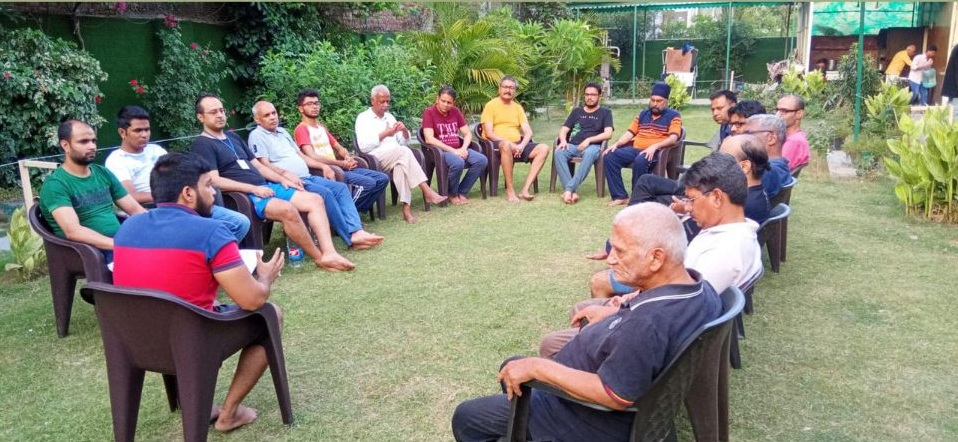
- Service is paired with reflection. After every camp, volunteers gather for a 30-minute group circle to share what came up — feelings, memories, surprises. The reflection is where most of the therapeutic value lives.
- Service is a long road. The volunteer programme is designed to extend years past discharge — alumni who have been sober for five or seven years are still active, often as campaign leads.
Volunteering for non-patients
Heartsprings is a registered charitable foundation. We welcome volunteers from outside the patient and alumni community — students, working professionals from Delhi NCR who want to contribute time, corporate CSR teams, women’s collectives, spiritual organisations. If you would like to join a Beat the Heat camp this summer or a blanket drive this winter, please reach out. There is no minimum commitment. Half a day at a single camp counts.
Why this matters for the centre too
Heartsprings was founded by a woman with a strong personal commitment to the philosophy that addiction recovery is not a private medical event but a slow re-entry into the world. The volunteer programme is the most visible expression of that philosophy. It is also why we are organised as a charitable foundation rather than a private rehab business — the campaigns and the centre are not separate activities, they are two halves of the same project.
We are not in the business of making people stop drinking. We are in the work of helping people remember that they were always more than their drinking.
If you would like to enquire about treatment at Heartsprings, or volunteer for an upcoming campaign — Beat the Heat, blanket distribution, or a food drive — please get in touch. We are based in Greater Noida and active across Delhi NCR.
Outpatient De-Addiction in Greater Noida: Treatment That Works Around a 9-to-6 (Not Against It)
